Showing posts with label trains. Show all posts

Thursday, August 14, 2025

Extending the Downeaster to New York and DC

The highly successful Downeaster has connected Maine to Boston for a quarter century and its plans call for greater frequency and extensions further into Maine. What if it was extended south to New York City and Washington, DC?

Two years ago, my family and I tried without success to recreate the East Wind route which was a seasonal train connecting Washington to Maine between 1940 and 1955. Despite having an hour to connect between Back Bay and North Station, delays due to heat restrictions caused us to miss it. Fortunately, we were able to hop on a commuter train to Newburyport and my folks picked us up from there. We took the C&J bus directly to South Station on the way home. The experience highlights a key impediment to connecting Maine with points beyond Boston. This year, our trip to Ogunquit, ME took 11 hours to drive from suburban Washington, DC, reiterating the need for a train option.

Grand Junction Option

Although both of Boston’s South and North Stations lack a direct rail connection, the MBTA uses the Grand Junction line to transfer its locomotives on the south side to the north side’s Boston Engine Terminal for heavy maintenance. The Downeaster would operate as a four-car section of a Northeast Regional train. After reaching South Station, a diesel locomotive would back up to the Downeaster section and pull it out towards the Grand Junction line where it would back up straight into North Station and a waiting 5-car Downeaster consist. After connecting the two sections, the train would pull out towards Maine, making all of the Downeaster's usual stops. 

Amtrak in Cambridge, MA on the Grand Junction line on a non-revenue move between Boston's North and South Stations (source) 

The Grand Junction track is in poor shape and lacks crossing gates at several busy Cambridge streets. To make the reverse move in a safe and timely manner, it should be upgraded to at least 30 mph (up from 5 mph today), crossing gates should be added at the four streets that lack them and medians should be added at all streets to deter drivers from going around the gates. Traffic signals would need to to be coordinated with crossing gates as well  Since this track is owned by the MBTA and very lightly traveled, constructing these improvements should be relatively straight forward. One complication is MassDOT’s plans to close the line for several years to rebuild I-90. 

Since the four-coach consist attached to two existing trains, this route adds relatively little additional operating cost besides the reverse move. It also has higher revenue potential than the current Downeaster route due to the distances and population of the destinations. Using summer 2025 timetables, Brunswick to Washington travel time would be 11:50-12:15 which is comparable to a busy summer day drive with several stops. If the Downeaster and Northeast Regional schedules were optimized to reduce connecting time, travel times would drop to 11:41 in both directions. 

Springfield Option

The East Wind initially ran between Washington, New York and Portland, using the line between New London, Worcester, Lowell and Haverhill to get to Maine. It later ran to Providence, following a different route to Worcester. However, neither line hosts passenger trains today and both would require expensive upgrades to produce a relatively slow, curvy and indirect route. Instead, the train would depart the Northeast Corridor in New Haven to run to Springfield and follow the Lake Shore Limited route to Worcester. It would then use the historic East Wind route which recently received a substantial upgrade from new owner CSX which allows 40 mph freight trains and potentially, passenger trains up to 59 mph. The train would take approximately 12:34 to go between Brunswick and Washington, DC. 

                                Amtrak's Lake Shore Limited in Worcester, MA (source) 


This route requires some additional capacity between Springfield and Worcester so part of the former second track should be restored. Capacity upgrades may be required on the Worcester-Lowell-Ballardvale line too. Eventually, positive train control and 79 mph top speed should be added. Since this train would run separately from the existing Downeaster service to Boston, capacity  upgrades may be required between Haverhill and Brunswick as well. 

To reduce operating costs, this train should combine with the Vermonter in Springfield. Long term, 2-3 additional separate Downeaster trains should be added with one terminating in New York City. 

About a third of Portland's airline passengers go to cities along the Northeast Corridor (770,000 per year) and for Manchester, it is about 25% (320,000). The latter just lost all of its flights to New York City. Given the increased flight delays and traffic impacts, a Downeaster southern extension will would be highly successful. 

Friday, December 22, 2023

Improving the Northeast Regional

The Northeast Regional is Amtrak’s busiest service, connecting Boston, New York and Washington. Here is what could be improved. 

Background

The Northeast Regional connects Boston, New York City and Washington, DC with some trains traveling to Springfield, MA and Virginia. While the Acela is marketed and priced towards premium business travelers, the Northeast Regional is its slower and cheaper cousin, trying to be all things to all people. While it has long been Amtrak's busiest service, it carried a record 9 million passengers in fiscal year 2023. 

Prior to Amtrak, the Northeast Corridor was owned by two railroads, the Pennsylvania Railroad which owned the line south of New York City to Washington and New York, New Haven and Hartford Railroad which owned the line to Boston. They cooperated to run some trains along the entire length, running five round-trips along the entire length as late as April 1971.

When Amtrak began in May 1971, there were nine round-trips between New York City and Washington, DC but only three extended to Boston. The remaining four round-trips from Boston required a transfer in New York City and one arrived too late for any connection.

Travel times were slow, taking 4:29-4:54 between Boston and New York City and 3:55 to Washington, totaling about 9:00. Amtrak gradually upgraded the tracks to reduce those travel times to 4:05, 3:15 and 7:35. In 2000, the line was electrified from New Haven to Boston which removed a time-consuming locomotive swap in New Haven.

Key improvements underway

While the Northeast Regional received new electric locomotives between 2013-2016, the train cars date back to 1975. In 2021, Amtrak ordered new trainsets from Siemens for delivery in the late 2020’s, naming them “Airo.”

For trips south of Washington, DC or to Springfield, MA, Amtrak must swap its electric locomotives for diesel, adding 0:15-0:35 to each trip. The new Airo trainsets will be dual mode, eliminating that swap. 

Amtrak has not released its exact seating capacity for its Airo trainsets but Siemens offers up to 74 coach class seats, 54 business class seats, 44 coach seats with a cafe and 62 coach seats with a cab control unit. The Airo trainsets are likely to have five coaches, one cafe/coach, one coach/cab and one business class car, totaling eight cars. This adds up to 476 coach seats and 54 business seats for a combined 530 seats, slightly more than capacity than the Northeast Regional’s seven-car Amfleet trainset (422 seats) or eight-car trainset (494 seats). 

Proposed improvements

While the new railcars are welcome, the Northeast Regional requires additional improvements to become the train of choice in the Northeast. 

Amtrak's Airo Trainset (courtesy of Amtrak)

Longer trainsets

Most Northeast Regional trainsets are seven cars long. While diesel locomotive pulling power and lower demand on the non-electrified sections to Springfield and Virginia do not warrant longer trainsets, the trainsets running on electrified segments should be 12 cars at minimum and up to 15 cars between New York City and Washington. While Amtrak’s initial order for the Northeast Regional was for 32 trainsets (256 cars), lengthening the trainsets to 12 and 15 cars would require an additional 158 cars (including a 20% spare ratio). Amtrak plans to replace most of its new Siemens ACS-64 electric locomotives with dual mode versions. However, retaining them for all-electric service will save Amtrak the cost of some new locomotives.

Increased frequencies

At present, Amtrak has not had enough cars or locomotives to add round-trips. As such, the Northeast Regional only runs every two hours south of Boston and hourly south of New York City to Washington, DC, totaling 18 daily roundtrips in 2023. The new railcar order should allow frequency should be doubled to hourly from Boston and twice per hour between New York City and Washington for a total of 36 roundtrips. 

Assigned seating

The Acela and Northeast Regional’s business class offer assigned seats. However, every other passenger must trudge up and down looking for a spare seat. If you are in a group of four or more people and board when the train is mostly full, you won’t likely be able to sit together unless the conductor has successfully shooed people out of a few pairs of seats facing each other. Assigning seats on the Northeast Regional will make it much easier for groups and families to sit together and help other passengers quickly find their seats upon boarding. 

Restored Inland Route

Massachusetts has funding to restore service to its Boston-Springfield, MA route, something I wrote about in 2016.

Unlike Massachusetts’ proposal which only restores service as far as Springfield, I propose running a train once every two hours between Boston, Springfield, and then all the way to Washington, DC and Virginia. This would allow Amtrak’s new dual-mode locomotives to operate in two non-electrified segments instead of one, reducing the number of dual-mode trainsets and allowing an all-electric service to run on the Shore Line route via Providence.

Faregates to replace conductors

Like most American railroads, Amtrak uses conductors to check passenger tickets. However, longer trainsets and frequent busy stops complicate ticket checking and many American railroads will simply add assistant conductors. However, that additional labor cost increases longer trainsets’ operating cost with no benefit to service. Amtrak should retain one conductor per train but use faregates to check tickets as is a common practice in Europe. That would will allow Amtrak to run longer and more frequent trains using the same number of employees today, increasing profits and reducing ticket prices.

Clockface timetable and standardized stopping pattern

The current Northeast Regional timetable has departures at different times: 6:10 AM, 8;15 AM, 9:20 AM from Boston for example. Clockface timetables have trains depart on the same minute each hour of the day such as 0:05 past the hour. That simplifies schedules for customers, employees and any other service that interacts with the train (commuter trains, intercity or local bus service etc). You can compare the 2023 timetable to a clockface version.

Amtrak's 2023 summer timetable


Proposed clockface timetable

Similarly, each Northeast Regional train has a unique stopping pattern. That pattern should be standardized into two patterns to provide a consistent and predictable schedule throughout the day. Here is the 2023 Northeast Regional timetable and my proposed clockface timetable.

Five smaller cities with limited Northeast Regional service should be dropped. Aberdeen (MD), Newark (DE), New Brunswick (NJ), Princeton Junction (NJ), and Newark Airport (NJ) all have commuter rail service. Those stations could also be served by a restored Clocker service to Philadelphia.

Restoring the Clocker 

One of the challenges with the Northeast Regional is that it serves differing levels of demand. For example, stations between New Haven, New York City and Philadelphia have substantial demand between them and if Amtrak sells too many Northeast Regional seats between those cities, they miss out on higher fares between more distance destinations and make it more difficult to fill seats on lower demand segments between Philadelphia and Washington, DC and New Haven and Boston. 

The solution is a dedicated, high-frequency, low-cost service between New Haven, New York City and Philadelphia, modeled on the Clocker service that Amtrak discontinued in 2005. The new Clocker service would better serve passengers looking to travel between those destinations and ensure the Northeast Regional can sell additional long-distance tickets. Passengers would still be able to buy a Northeast Regional ticket between New York City and Philadelphia but it would cost more than the Clocker, reflecting its fewer stops and faster timetable. I last wrote about the Clocker in 2019.

Amtrak serves two low platforms in Mystic and Westerly. Both platforms should be raised to provide level boarding and since they are on curves, retractable edges should be used to maintain freight train clearances. Level boarding reduces boarding time from 2-4 minutes to 0.5-1 minute and makes it easier for passengers with mobility impairments, large luggage, strollers or bicycles to quickly and easily board or alight. It negates the need for costly, slow and unreliable ADA lifts at each station.

All of these improvements will significantly increase Northeast Regional's ridership from 9 to 18 million passengers and more than 27 million if longer trainsets are ordered, diverting a significant portion of travelers from other modes to the train. While the Northeast Regional earned a $108 million profit in fiscal year 2023, the additional passengers could increase it to more than $500 million. 

Saturday, August 12, 2023

Historic Passenger Trains Linking Buffalo and New York City

Today’s travelers going between New York State’s two largest cities, Buffalo and New York City, can drive, fly or take Amtrak or the bus. But as late as the 1950’s, travelers could pick from 10 day trains and 11 overnight trains each day, offered by five railroads. I created a spreadsheet showing each railroads' timetables. An interactive version of the map is available here. 

Map showing five railroads' routes
Brown: Pennsylvania Railroad
Red: Lehigh Valley Railroad
Yellow: Delaware, Lackawanna & Western Railroad 
Orange: Erie Railroad
Green: New York Central Railroad

Delaware, Lackawanna & Western Railroad (DL&W) ran a daylight service from Hoboken, NJ to Buffalo via Scranton, Binghamton, Elmira and Dansville. The DL&W's Buffalo station was built along the waterfront to facilitate train-to-ship transfers and still exists today as the repair shops and storage yard for the Buffalo Metrorail. Of the five routes, it was the second fastest and shortest by mileage. The most famous named train was the Phoebe Snow. Created in 1900 as a fictional woman clad in a white dress, this marketing character was named to promote the anthracite coal used by the DL&W which burned cleaner than other types. Formerly known as the Lackawanna Limited, the train was renamed in 1949 for Phoebe Snow and streamlined at that time, taking 8:15. The Snow was replaced in late 1966 with an overnight service which was discontinued in 1969, ending DL&W service between Buffalo and New York City. 

The ne'er-do-well Erie Railroad was the first to quit the New York City-Buffalo route in 1951. Their unnamed overnight service left Jersey City, NJ in the late evening, arriving in Buffalo after lunch the next day, taking more than 12 hours. Their route was one of the oldest (some sections opened in 1851) and slowest. They were also the first to abandon their Buffalo station in 1935, moving to the Lehigh Valley's station. The service stopped in Port Jervis, Binghamton, and Elmira, the latter two paralleling the DL&W. The route followed every curve of the scenic Delaware River from Port Jervis to Deposit and ran over a high bridge over the falls of Genesee River at Letchworth State Park.

Unlike the Erie and DL&W's New Jersey stations, Lehigh Valley Railroad (LV) used the more convenient Pennsylvania Station in New York City. Its fastest train ran between Buffalo and New York City in about 9.5 hours. Stopping in Allentown, Wilkes-Barrie and Ithaca, its Black Diamond daytime service was named for the coal it hauled out of Pennsylvania. The Diamond’s last run was in 1959. The LV also ran The Star, a dedicated overnight service between Buffalo and New York City. Its Maple Leaf service ran overnight between Toronto and New York City in almost 13 hours, slightly slower than Amtrak’s present-day Maple Leaf. The LV’s remaining passenger trains ended in 1961 and its Buffalo station was demolished in 1960 to construct the William J. Donovan State Office Building, named for the Buffalo-born found of the CIA-predecessor agency. After it closed in 2007, that building was also slated for demolition but was recently converted into a hotel and restaurant.

The New York Central Railroad had the best route between Buffalo and New York City with no mountain ranges to cross and large cities in between. It also had the best-located station in New York City at Grand Central in the heart of midtown Manhattan. Of the five historic passenger train routes between Buffalo and New York City, their route is the only one that still hosts passenger trains. The Central ran multiple daytime trains in as little as 7.5 hours until Amtrak took over in 1971. The route had a number of named trains but among the most famous is the Empire State Express which lends its name to the modern-day Empire Service operated by Amtrak. Five trains provided day time service, five provided overnight service and several others stopped in Buffalo in the middle of the night. The Central used the magnificent Buffalo Central Terminal as did Amtrak in 1979. Starting 1967, the Central reorganized it's trains into a clockface timetable, replacing most of its overnight trains with day trains departing New York City every 2 hours on the half hour.

The Pennsylvania Railroad operated daylight and overnight service between Buffalo and New York City. Its route was the slowest and least direct, stopping at North Philadelphia and Harrisburg before turning north to Buffalo with stops at Williamsport and Olean. The final years required a change of train in Harrisburg to catch the Northern Express or Southern Express which ran between Buffalo and Washington, DC. The day train took 12.5 hours and the overnight service left shortly after dinner to arrive in Buffalo by 8:30 AM. The Pennsy used Buffalo Central Terminal in its later years. This route last ran the day before Amtrak began in 1971.

Today, only four daily day trains connect New York City with Buffalo, taking 8.25 hours, about 45 minutes slower than Amtrak's initial 1971 schedule.

Sunday, July 2, 2023

Retracing the route of the East Wind

Fed up with driving and buoyed by an Amtrak child fare sale, I recently booked three tickets from Alexandria, VA to Dover, NH with a connection in Boston for a summer trip. This modern-day route parallels the East Wind, a seasonal day train that briefly connected Washington, DC with Maine.

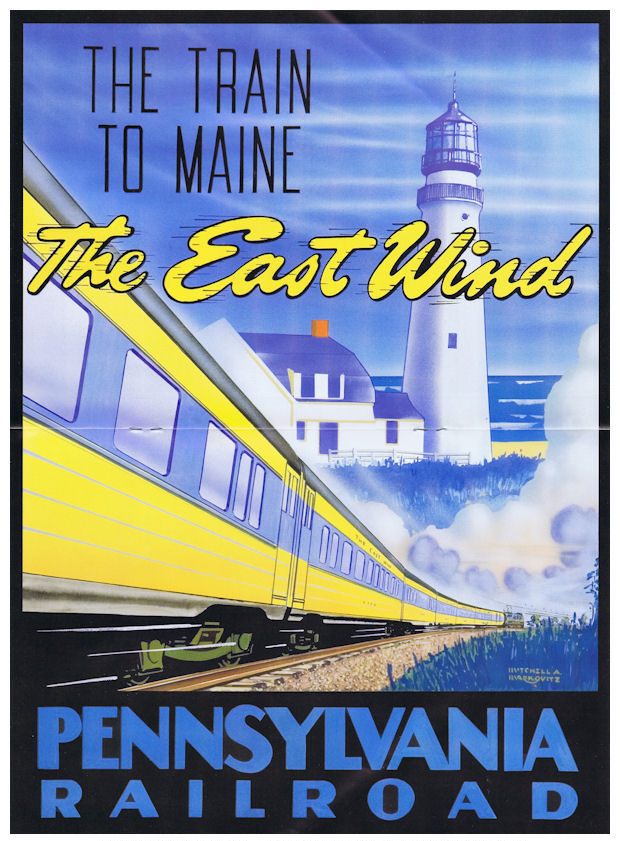
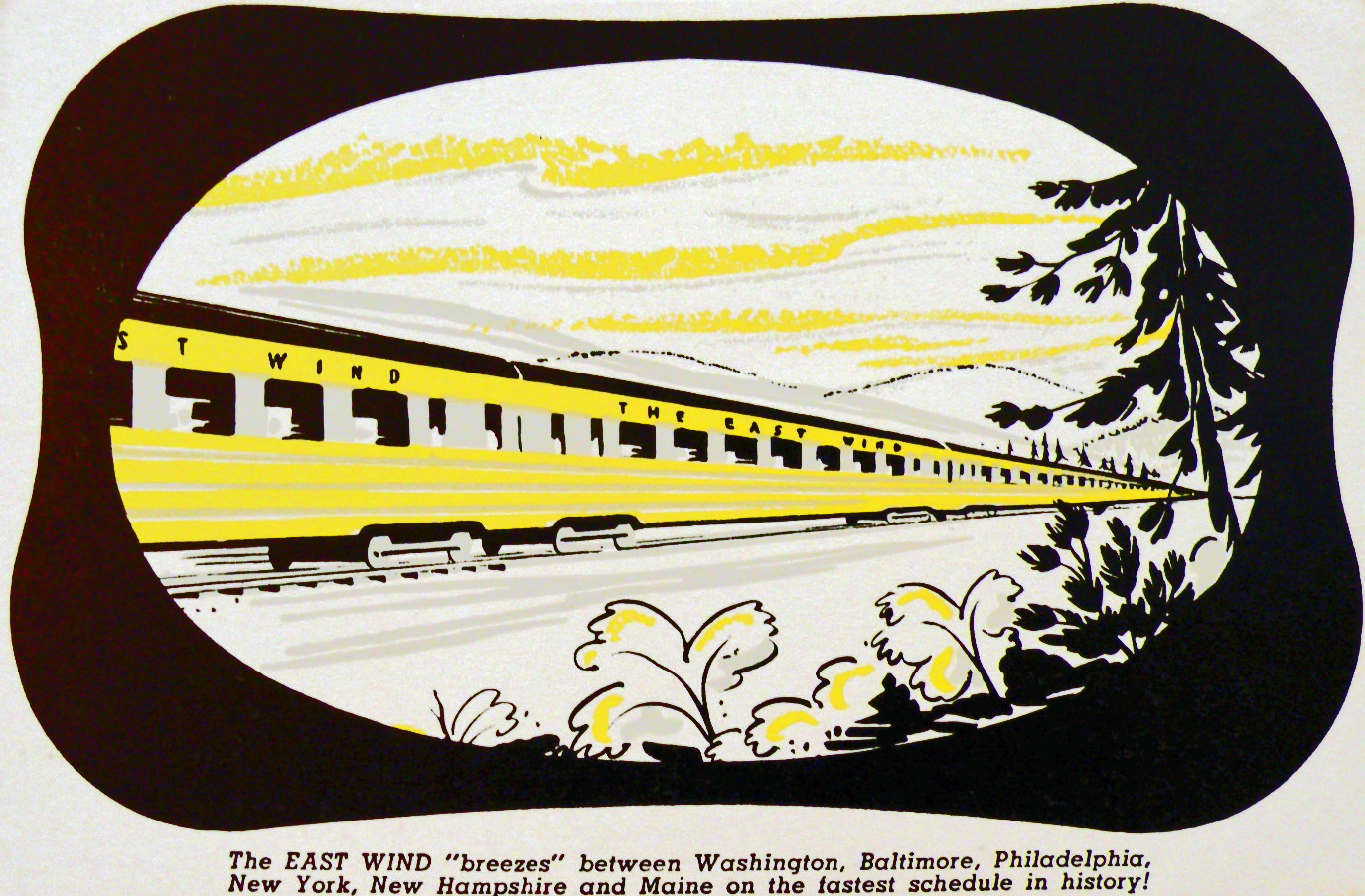
In the days before widespread air conditioning and air travel, many Americans would travel north to northern New England and Canada for vacations in the cooler air. Capitalizing on this trend, the East Wind began in 1940 as a limited stop, daytime all-coach seasonal service from Washington, DC to Bangor, ME. Conceived by the Boston and Maine Railroad (B&M), it also operated on the Maine Central, New Haven Railroad, and Pennsylvania. At the time, most long-distance trains were overnight sleeper services including the B&M’s own Bar Harbor Express and State of Maine and those additional fares for the sleeper service went to the Pullman Company instead of the railroads themselves.

The East Wind’s consist included a baggage car, three coaches, a tavern-lounge car and a dining car. For its first three seasons, the two trainsets were painted yellow but after World War II, the trainsets had the liveries of the operating railroads. The train would have held 200-250 passengers depending on how many seats each coach held.

                    1941 Timetable                                                1955 Timetable

Here are some of the timetables from 1941-1955 as well as two potential timetables for a restored service.

Initially, most of the train ran between Washington and Portland with two cars being attached to the Pine Tree in Portland for service to Bangor. In 1947, the terminus moved from Washington to New York Penn Station although thru car service was maintained to Philadelphia. In 1950, Grand Central Terminal replaced Penn Station as the terminus, removing the Pennsylvania Railroad as one of the East Wind’s operators. The train initially had connecting service in Lowell to Plymouth, NH via Lake Winnipesaukee, Rockland, ME with a connection in Portland, and Lewiston, ME in Portland as well.

The B&M’s annual reports noted that the East Wind revenue was outstandingly good for its first several seasons. One reason was that it was marketed as an alternative to driving. One poster read, Who now would think of driving over hot, crowded highways, when so superbly appointed a train awaits?


When the East Wind began, most of the interstate highways had yet to be constructed and while some of the main travel routes such as Route 1 had interstate-like elements, with limited grade separation and higher speed limits, roadside gas stations, restaurants and motels had sprung up alongside too, making these routes dangerous, congested and slow. However, the advent of tolled turnpikes and interstates significantly reduced travel times and relegated roadside amenities to exits and rest stops. For example, following Route 1 instead of I-95 just in Maine adds one hour of travel time. As more interstates were constructed, train travel times were unable to keep up and more people abandoned trains for the automobile. By 1955, the East Wind ran for its last summer. While it was scheduled to run through September 11, the train ended three weeks early thanks to a hurricane washing out tracks in southern New England.

Resuming direct train service to northern New England is feasible. Following its original route from Washington, DC to New Haven, it would then use the recently upgraded Hartford Line to Springfield. It would use CSX freight railroad’s Springfield-Worcester line which Massachusetts plans to upgrade to add more service. In Worcester, it would switch to a lightly used CSX line that has not hosted passenger trains since 1960, running to Ayer. It would then use CSX’s line to Lowell and Ballardvale where it would link to the existing Downeaster service. That 52-mile section of track would require upgrades to allow 79 mph passenger trains. 

One way to restore service quickly is to add five cars to the Vermonter and split that train to Springfield, allowing five new cars to run to Maine. If the new train replaces one of the Downeaster’s frequencies, only five new cars and one additional locomotive would be needed. Initially, the train would take 11:46 between Washington and Portland (see timetable below), slower than the East Wind’s 11:15, but subsequent upgrades could reduce travel time to 9:00.

Until the East Wind returns, I look forward to my train trip via Boston.