Sunday, July 2, 2023

Retracing the route of the East Wind

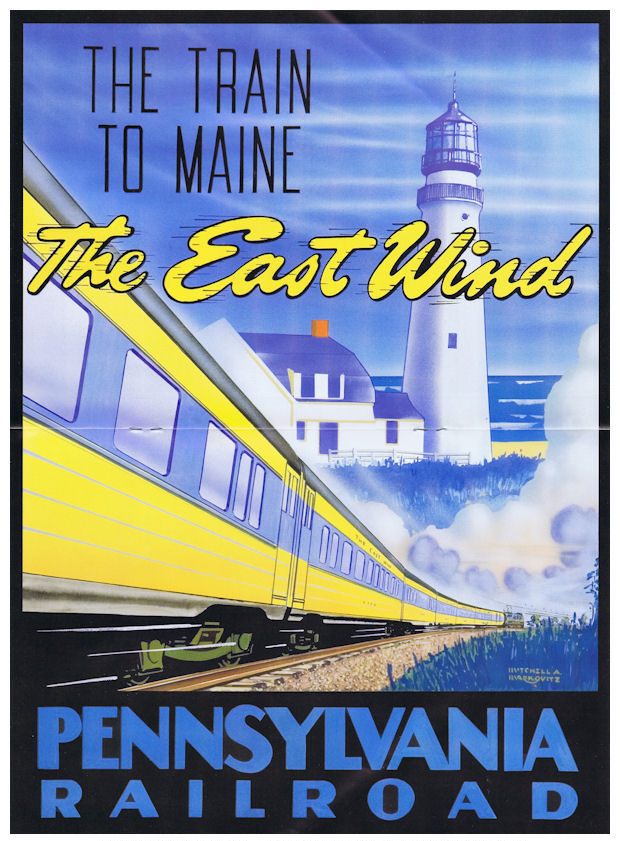
Fed up with driving and buoyed by an Amtrak child fare sale, I recently booked three tickets from Alexandria, VA to Dover, NH with a connection in Boston for a summer trip. This modern-day route parallels the East Wind, a seasonal day train that briefly connected Washington, DC with Maine.

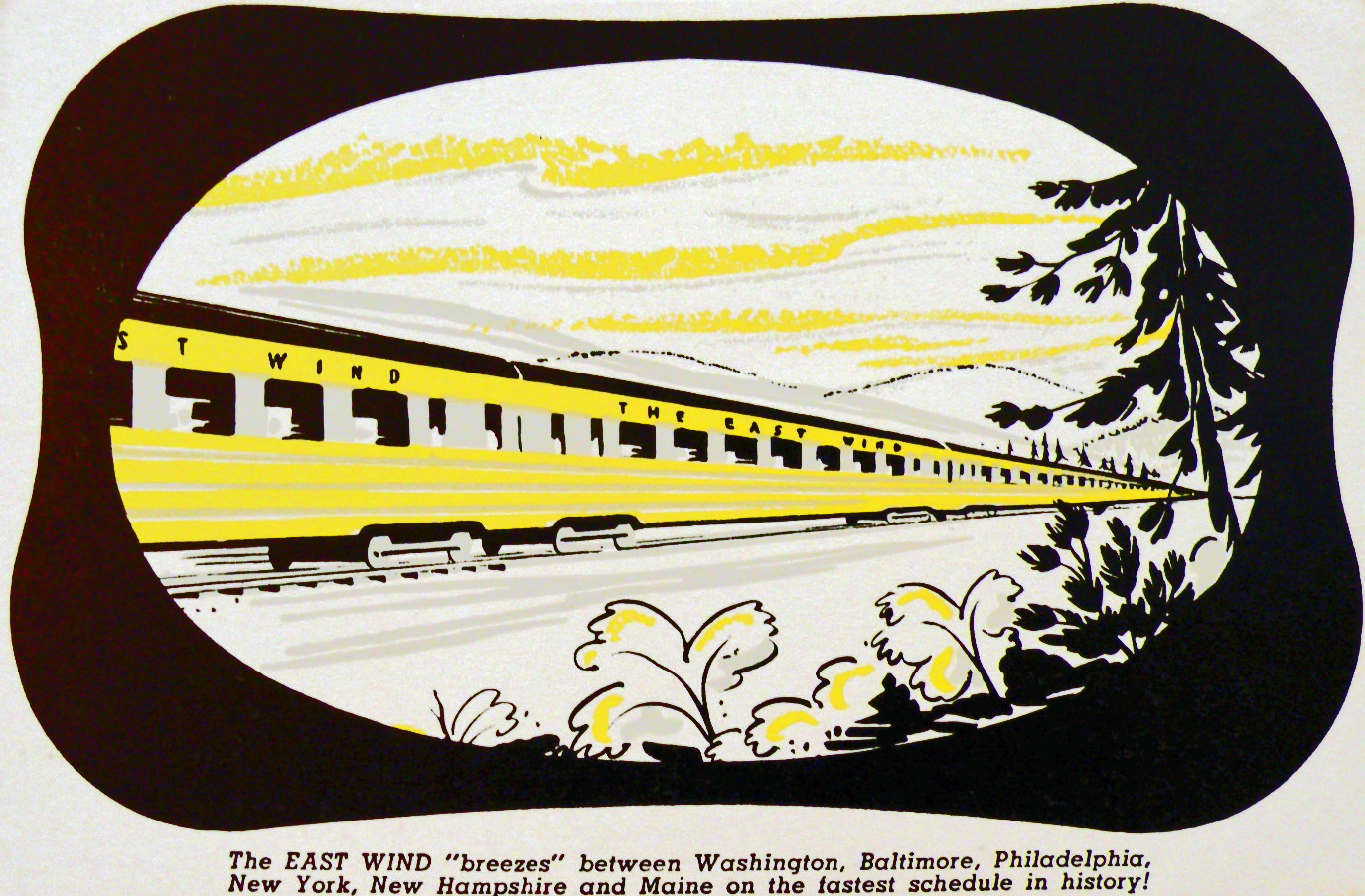
In the days before widespread air conditioning and air travel, many Americans would travel north to northern New England and Canada for vacations in the cooler air. Capitalizing on this trend, the East Wind began in 1940 as a limited stop, daytime all-coach seasonal service from Washington, DC to Bangor, ME. Conceived by the Boston and Maine Railroad (B&M), it also operated on the Maine Central, New Haven Railroad, and Pennsylvania. At the time, most long-distance trains were overnight sleeper services including the B&M’s own Bar Harbor Express and State of Maine and those additional fares for the sleeper service went to the Pullman Company instead of the railroads themselves.

The East Wind’s consist included a baggage car, three coaches, a tavern-lounge car and a dining car. For its first three seasons, the two trainsets were painted yellow but after World War II, the trainsets had the liveries of the operating railroads. The train would have held 200-250 passengers depending on how many seats each coach held.

                    1941 Timetable                                                1955 Timetable

Here are some of the timetables from 1941-1955 as well as two potential timetables for a restored service.

Initially, most of the train ran between Washington and Portland with two cars being attached to the Pine Tree in Portland for service to Bangor. In 1947, the terminus moved from Washington to New York Penn Station although thru car service was maintained to Philadelphia. In 1950, Grand Central Terminal replaced Penn Station as the terminus, removing the Pennsylvania Railroad as one of the East Wind’s operators. The train initially had connecting service in Lowell to Plymouth, NH via Lake Winnipesaukee, Rockland, ME with a connection in Portland, and Lewiston, ME in Portland as well.

The B&M’s annual reports noted that the East Wind revenue was outstandingly good for its first several seasons. One reason was that it was marketed as an alternative to driving. One poster read, Who now would think of driving over hot, crowded highways, when so superbly appointed a train awaits?


When the East Wind began, most of the interstate highways had yet to be constructed and while some of the main travel routes such as Route 1 had interstate-like elements, with limited grade separation and higher speed limits, roadside gas stations, restaurants and motels had sprung up alongside too, making these routes dangerous, congested and slow. However, the advent of tolled turnpikes and interstates significantly reduced travel times and relegated roadside amenities to exits and rest stops. For example, following Route 1 instead of I-95 just in Maine adds one hour of travel time. As more interstates were constructed, train travel times were unable to keep up and more people abandoned trains for the automobile. By 1955, the East Wind ran for its last summer. While it was scheduled to run through September 11, the train ended three weeks early thanks to a hurricane washing out tracks in southern New England.

Resuming direct train service to northern New England is feasible. Following its original route from Washington, DC to New Haven, it would then use the recently upgraded Hartford Line to Springfield. It would use CSX freight railroad’s Springfield-Worcester line which Massachusetts plans to upgrade to add more service. In Worcester, it would switch to a lightly used CSX line that has not hosted passenger trains since 1960, running to Ayer. It would then use CSX’s line to Lowell and Ballardvale where it would link to the existing Downeaster service. That 52-mile section of track would require upgrades to allow 79 mph passenger trains. 

One way to restore service quickly is to add five cars to the Vermonter and split that train to Springfield, allowing five new cars to run to Maine. If the new train replaces one of the Downeaster’s frequencies, only five new cars and one additional locomotive would be needed. Initially, the train would take 11:46 between Washington and Portland (see timetable below), slower than the East Wind’s 11:15, but subsequent upgrades could reduce travel time to 9:00.

Until the East Wind returns, I look forward to my train trip via Boston.


Monday, June 5, 2023

Amtrak Night Train

Europeans are rapidly restoring overnight train routes as a way to combat climate change. Amtrak could implement a similar service in the US and augment its existing overnight trains with a new sleeper product.


Cheaper sleeper product

Amtrak’s current sleeper products, the bedroom and roomette, are in high demand and take up similar amounts of space compared to European sleepers. On most days and for most trains, a bed is an expensive luxury and therefore, overnight passenger trains are not financially feasible for most passengers. Both products include "free" meals and most cars have one attendant to make up beds and serve the passengers throughout the night. Most trains have a dining car too.


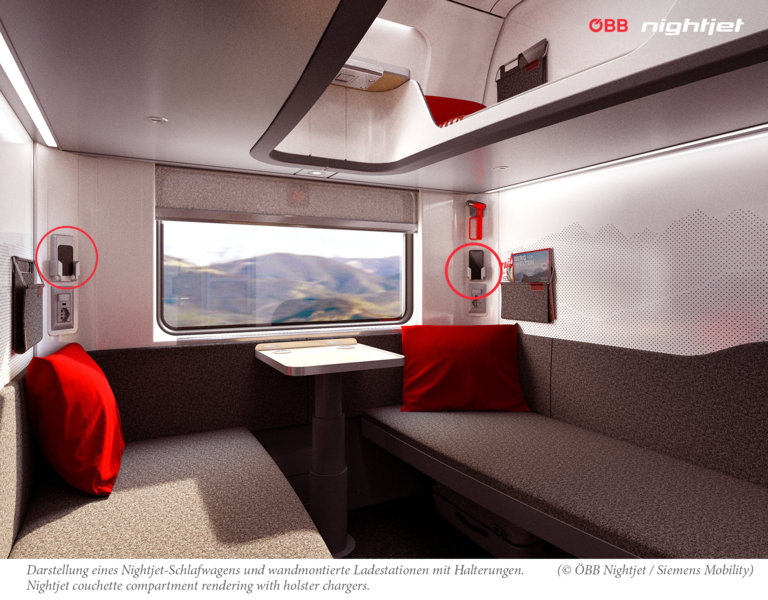
Austria's Nightjet service also offers a bedroom product similar to Amtrak. But Nightjet also offers couchettes which take up a similar amount of space to a bedroom but can sleep up to four or even six passengers, spreading the cost of service over more passengers than Amtrak's two passengers per bedroom. Similarly, Nightjet's three-person couchette occupies as much space as a two-person roomette. Nightjet attendants bring a light breakfast to each room and couchette rather than towing a dedicated dining car. In terms of staffing, couchette passengers make up their own beds instead of relying on one attendant per car. Nightjet's handful of staff are contractors and perform multiple roles such as attaching cars and serving breakfast. Like Amtrak, Nightjet routes are partially subsidized by the government.

Couchette in newest Nightjet trains with four beds

Routes

Most Nightjet routes take at least six hours to drive and depart in the evening and arrive in the morning. Amtrak's routes would make stops between 6 pm and midnight and run nonstop until 6 am.


California Night Train

A private company recently proposed reconnecting Los Angeles with San Francisco using refurbished rolling stock to offer a luxury product. Amtrak could offer a lower-cost option to more destinations, particularly San Diego, as this intra-state travel market is enormous. For two years in the early 1980's, Amtrak offered the Spirit of California sleeper service between Los Angeles, Oakland and Sacramento. Amtrak's Night Train could initially serve those markets via a connection to the Capitol Corridor and eventually offer dedicated sleeping cars once demand is built up. While the Coast Starlight connects Los Angeles and San Jose, San Diego and San Francisco require a connecting train. The Coast Line between Los Angeles and San Jose is relatively uncongested in terms of freight trains and no track improvements would be necessary. Proposed timetable


Rocky Mountain Night Train

Like San Diego and Los Angeles, Denver and Salt Lake City are also an eight hours drive apart. The California Zephyr offers a day train between the two cities westbound. But eastbound, it departs at 3 am and takes 15 hours, a perfect travel time for overnight service. Both cities offer buses, light rail and commuter rail services. Due to the decline of coal, the route sees fewer freight trains than even a decade ago so no track improvements would be required although a new connection in Provo would allow the service to use Frontrunner's passenger track and stations such as Ogden.


Northeast Night Train

Amtrak offered this route between Boston and Washington until 2003 and even resumed it for 8 months in 2021. For the 2021 resumption, Amtrak merely coupled a few sleeper cars to an existing overnight coach train. The Night Train service would offer both sleeper and couchette service and could eventually expand to up to 12 cars depending on demand.

map of three routes in California, Colorado and Utah and the Northeast


Rolling stock

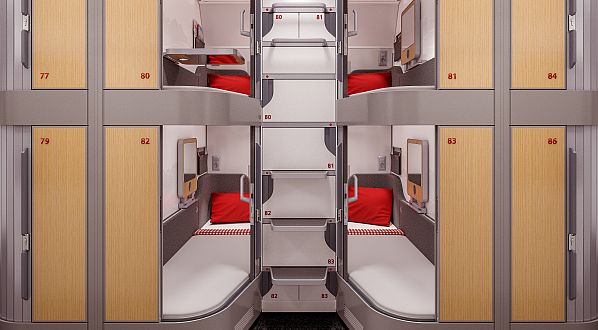
Amtrak recently completed a decade-long order to obtain 25 Viewliner sleeper cars, providing some spare cars for the first time since the late 1990s. Amtrak also ordered similar coaches to the Nightjet of the future rolling stock which will enter service next year. Those seven-car sets offer 2 sleeper cars (up to 20 passengers in 10 rooms), 3 couchette cars (28 minisuites for one passenger and 3 couchettes holding up to 12), a service coach and a 66-seat coach. Amtrak could simply tack on some couchette cars to their existing order. Nightjet's minisuites for single travelers do not force strangers to share a room, a key challenge with couchette service. Amtrak and its predecessor railroads once operated the Slumbercoach which had 24 single rooms and 8 two-person ones which cost significantly less than roomettes and bedrooms.

Four mini-suite beds for individual travelers

Mini-suites from Rail Journal


Additional cars could be ordered for Amtrak's shorter one-night long-distance services such as the Capitol Limited and Lake Shore Limited. Initially, spare Viewliners and Amfleets would be used but if the routes are successful, newer models could replace them. While coach seating could be sold at a low price for overnight travelers, it could also be used by local passengers to provide early morning and late evening service in places where it would not be economical to run a dedicated day train.


Expansion

Should these three routes be successful, additional routes could be added such as:

  • Washington to Montreal via Vermont (last operated in 1995)
  • Chicago to Minneapolis (last operated in 1981)
  • Boston to Raleigh and Charlotte
  • Boston to Pittsburgh
  • Washington to Cleveland and Detroit
  • Atlanta to Miami
  • Atlanta to Dallas
  • Atlanta to New Orleans
  • Denver to Dallas
  • New Orleans to Dallas
  • St. Louis to Detroit and Minneapolis
  • New York City to Toronto (last operated in 1995)
  • Washington to Brunswick (Maine)

Sunday, October 23, 2022

Henson Creek Trail


I rode the Hensen Creek Trail for the first time despite living nearby for 6 years. The trail runs from Oxon Hill Rd for 5.7 miles to Temple Hill Rd in Prince Georges County, Maryland.


I began by riding 8.75 miles to the trail. After crossing the Wilson Bridge, I rode up a sidepath adjacent to the MGM Casino. Having ridden up the wicked steep Oxon Hill on my non-electric bike and with a tandem partner, riding up via e-bike was a lot of fun. Riding south along Oxon Hill Rd is a contrast of experiences, from a sidepath along four-lane stroad, bike lanes along a two-lane road, a 550’ long southbound only protected bike lane, and underused parking lanes with shared travel lanes. There is a short dashed green bike lane near the trail entrance. 


The trail itself is well-shaded and generally in decent physical shape with just one large root bump. In several places, Henson Creek has eaten away parts of the trail but fortunately, all of those sections had been repaired relatively recently although one repair looked it would be undermined during the next heavy rain storm. 


However at the Tucker Road Community Center, the trail dumps riders into a parking lot with no wayfinding signs to the next section. After consulting Google Maps, I rode along Tucker Rd’s wide bike lanes, turned right into the Tucker Road Athletic Complex and eventually picked up the trail again along a maintenance road. This was a frustrating and easily fixable problem. Tucker Rd was the only grade crossing for the entire 5.8 miles! Other parts of the trail
have Dutch-style mushroom wayfinding markers.


Despite being a warm fall day, I saw only about a dozen people using the trail including just three other cyclists, a sharp contrast to how busy many other trails are in the region. Part of this is due to lack of connectivity. Getting from the Wilson Bridge to the trailhead is 5.3 miles in less than family-friendly conditions. I could have saved 2 miles by going via bike lane-less Kerby Hill Rd and Livingston Rd but those routes seems less than safe. At the northern end, the nearest trails are more than four miles away in Washington, DC. Connecting trails at both ends expands the pool of potential users. 


The other reason I suspect there were few users is because there are just four trail spurs to nearby homes, only one of which was multi-family neighborhood. There are nine multi-family apartment and condo complexes and three single-family home neighborhoods with no direct, convenient connections to the trail. Abutting neighbors are often the most frequent trail users yet Prince Georges County has no plans to connect any of these complexes to the Henson Creek Trail.


Author at the north trailhead 
Fortunately, there are plans to build a 2-mile trail connection between Oxon Hill and the mid-point of Henson Creek Trail near Tucker Road Community Center. The same plan calls for an extension to Branch Ave Metro which has a burgeoning multi-family neighborhood. Hopefully, those plans will make Henson Creek Trail a more accessible option.


Friday, January 21, 2022

Interborough Express: Phase I

Governor Kathy Hochul proposed connecting Brooklyn and Queens with new transit. Here is how to build it in the cheapest and fastest way possible. 

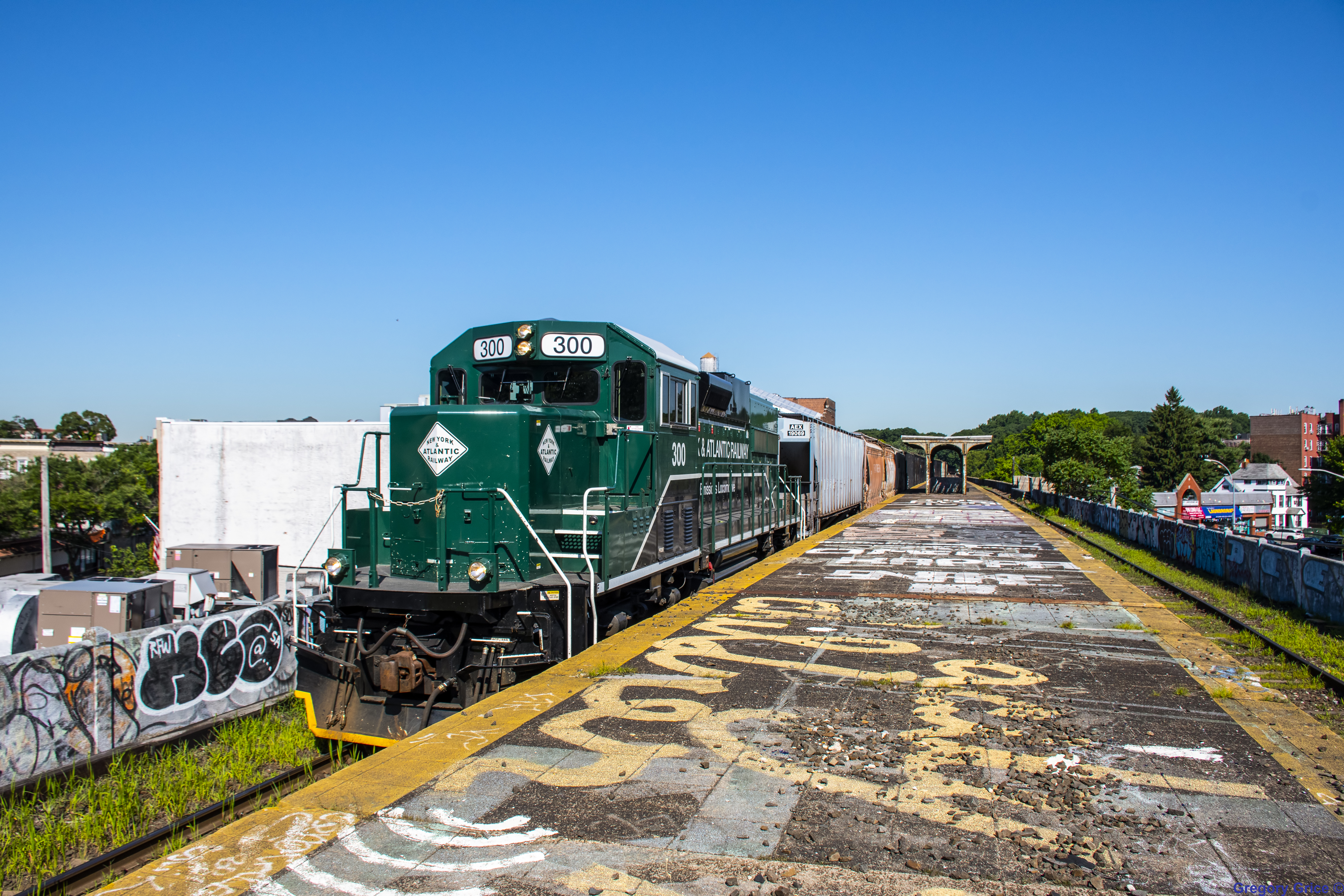
Brooklyn and Queens have more residents than Manhattan yet have only a single dedicated subway service connecting them, the maligned G Train. All of the other lines run to and from Manhattan. Providing a circumferential mass transit link between the two boroughs would reduce travel times and boost ridership on all subway routes connecting to the new line. Fortunately, there is an existing right of way, the Bay Bridge Branch, which provides a circumferential route. The line is owned by a public entity, the Long Island Rail Road (LIRR) and is only used for a few freight train trips per day operated by the New York and Atlantic Railway (NYA).

While the proposal contemplates different transportation modes, buses, light rail and conventional rail, the latter is the superior option. First, freight trains can use the same track as the passengers use so a third track along the entire route would not be required. Second, conventional rail does not require physical separation between freight trains, providing significant construction savings.       

Passenger Infrastructure 

Although the MTA assumes third rail electrification, the line should use overhead catenary wires instead. The line was electrified with this technology in 1927 although it was removed in 1968. This would simplify a future extension to the Bronx which uses the same catenary. Third rail is not as efficient as catenary at higher speeds and all new construction conventional rail lines use catenary for that reason. Two passenger tracks would the entire length of the line and have numerous crossovers to allow late night single track operations for maintenance and to allow freight trains to access customers.

The line should construct a passenger railcar storage yard at 65th St and convert space under the Bay Ridge Air Rights buildings into maintenance facilities. The yard is owned by the city of New York and only half it is is used. 

Each station should have platform screen doors to prevent people from falling on the tracks. This would also discourage people from hopping on passing freight trains which would be relatively easy from a high platform and due to slow speeds. Freight cars are slightly wider than passenger cars and if operated at higher speeds, they will jostle around and scratch the platform edges. 

While the proposal states all platforms would be high level, the MTA should use island platforms in as many locations as possible to save money. While some freight railcars such double-stack cars are too wide for high platforms, the NYA operates throughout Long Island next to high platforms without any problem, they do not operate wider railcars due to other clearance issues nor do their trains operate at higher speeds. Only three stations would require NYA trains to run adjacent to platforms at Avenue I, Avenue H and Flatbush Ave.

Almost all stations would be built within the existing right of way and at grade. However, the line passes under Broadway Junction via four single-track tunnels. While it may be tempting to skip this station due to perceived challenges building underground, it is too busy, hosting more than 100,00 passengers per day. I propose retaining track 1 for freight service only and using tracks 2 and 4 for passenger service. Track 3 would become an island platform between tracks 2 and 4 and would only require digging small openings to the train doors. Platform screen doors would be required. The line would connect via stairs and elevators directly to the IND platforms and the IND mezzanine. 

Freight infrastructure and operations

The NYA is well-versed in operating on lines with lots of passenger trains. The LIRR dispatchers can give NYA crews as little as 15 minutes to serve a local customer. NYA uses the Bay Ridge Branch to connect to their railcar float at 65th St Yard, allowing cars to be barged to New Jersey instead going north to Albany to cross the Hudson River. The NYA also uses the line to serve local customers in the Brooklyn Army Terminal and Brooklyn Marine Terminal and serve five trackside customers between Broadway Junction and 2nd Ave. Per the MTA, the NYA makes one! round-trip per day on the Bay Ridge Branch.

While the NYA uses a single track along much of the corridor, the MTA claims that one, preferrable two exclusive freight tracks are required along the entire corridor to accomodate future freight growth. The MTA claims that a cross-harbor freight tunnel would increase the number of freight trains to over 21 per day. First proposed in the 1920's, this tunnel has never been financially feasible and is unlikely to ever be constructed. Even if it was built, most of that new freight traffic would have to operate during offpeak hours if it wanted to go east of Jamaica or north of Hellgate Bridge because the high passenger volume precludes freight service during peak hours. The largest US freight railroads have large portions of single track along their busy main lines so the MTA's assumption that the NYA cannot operate with one track is a costly falsehood.

Between the Lower Montauk Branch and Broadway Junction, I propose two freight tracks on the east side of the passenger tracks. The freight line would narrow to one track through the East New York Tunnel under Broadway Junction. South of that tunnel to Ralph Ave, two freight tracks would be retained on the east side. Freight customers Agristar and M&M would retain dedicated sidings and M&M’s siding would have increased spacing or even a wall to ensure the materials from the top-loading cars do not spill onto the passenger trains. Access to those customers would be only during offpeak hours which is how the NYA serves many of its other customers today. Between Ralph Ave and 62nd St, there is only space for two tracks so freight trains and passenger trains would have to share space for about 3.25 miles. Since the line is owned by the LIRR, they could only dispatch the NY&A’s approximately single daily freight train during off-peak hours. From 62nd St to the 65th St Yard, there is space for two freight tracks. 

North of the Lower Montauk Branch, the line is called the Fremont Industrial track and owned by CSX. Built to accomodate two tracks, the line has one track today. Between one and three daily roundtrips are made to the NYA's Fresh Pond Yard on the Lower Montauk Branch. Since the Fremont Industrial track crosses over the Lower Montauk Branch via a bridge and there is no direct connecting track, the freight track must stop just south of the bridge, detach the CSX locomotive, and the NYA locomotive must then attach to the freight train and reverse back into the Fresh Pond Yard. 


This is a time-consuming interchange which is not compatible with passenger trains. I propose acquiring the Fremont Industrial track between the Lower Montauk to Hellgate Bridge from CSX and rerouting most freight trains via the Harold Interlocking to the western end of the Lower Montauk Branch in Long Island City. While this is a longer route and would require freight trains per day to mingle with passenger trains during off peak hours, there are just 1-3 freight trains per day. The freight trains could also operate slightly faster on the higher quality passenger tracks and would not have to reverse into Fresh Pond Yard, saving CSX and NYA a significant amount of time and effort. NYA's curve has radius of 300', requiring specialized locomotives to handle the curve and lubricators to reduce noise so retiring it from most manoevers would likely be welcomed. 


One operator per trainset 

Both the LIRR and Metro North Railroad (MNR) suffer from high operating costs. While some of that cost relates to different inspection and maintenance standards for conventional rail compared to subways or buses, much of it is due to having two or more crew on board. In addition to an engineer driving the train, both the LIRR and MNR use one or more conductors to check tickets, just like the first passengers trains did in the 1830s. Most urban railroads have replaced conductors with faregates and deploy some inspectors to randomly verify people have tickets. Since most passengers would likely be traveling only a few stops, it would be difficult for conductors to check tickets before people arrived at their next stop. Operating trains with engineers alone would reduce operating costs to allow more service.

Rolling stock 

The MTA falsely assumes that conventional rail is slower than light rail, likely relying on sluggish performance by their existing LIRR rolling stock. This project would take advantage of new federal rules allowing lighter-Euro spec rolling stock with high acceleration. Each railcar should have at least three doors to speed up loading and unloading. The MTA proposes longitudinal seating like on the subway and due to the short distances, the trainsets do not require restrooms. Initial trainsets should be about 510’ long but expandable to longer lengths. Phase I would require 18 trainsets for revenue service and 4 spare trainsets. 

Travel time and timetable 

The MTA calls for trains running every five minutes, 12 trains per hour. Running this frequency all day long would reduce transfer times between the subways, reducing travel time to make the service more attractive. I propose running that 12 trains per hour frequency between 6 AM and 11 PM. Overnight, trains would run every 15 minutes or 4 trains per hour to allow passenger trains to operate on one track and freight trains or maintenance to occur on the adjacent track. While the MTA estimates a 45-minute long trip, I estimated that a high-performance trainset could make the 14.8-mile trip in about 35 minutes, averaging 25 mph, more than 8 mph faster than the subway’s average speed.

Conclusion

By abandoned some misconceptions about conventional railcar performance, need for a dedicated freight track and better understanding how freight rail actually works, the Interborough Express could be a model for how to build a faster, cheaper transit project.   

Saturday, November 27, 2021

Amfleet Replacement Order

At long last, Amtrak announced a replacement railcar order for its Amfleets and Metroliner cab cars which date back to the late 1960’s. However, the order will not add capacity to Amtrak’s busiest route and Amtrak made odd choices of locomotive power.

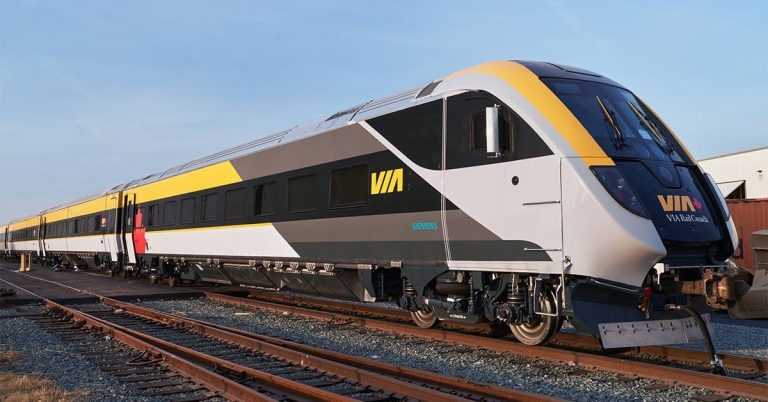
In April 2021, Amtrak announced that Siemens Mobility had been selected as the preferred bidder and signed the contract in July for 83 trainsets. Any route which uses Amfleet or Metroliners will receive this new equipment. Siemens has built almost all of the new intercity passenger equipment in recent years including all of Amtrak’s locomotives and has just begun delivering equipment to California and the Midwest. The new equipment will be from the Siemens Venture line which is also used by Brightline in Florida and is being delivered to VIA Rail, Amtrak's Canadian equivalent. The Venture Coach is based on the Viaggio Comfort series used by ÖBB for intercity service in Austria. ÖBB primarily operates locomotive-hauled trainsets semi-permanently coupled together which is exactly what Amtrak plans.

Siemens Venture Coach for California's San Joaquin, Source from Caltrans


Details about the order have been scarce but thanks to the efforts of Worldwide Railfan, we now know more about the trainsets’ consist and estimated delivery dates. Here is a chart I made using his very helpful video. Since Amtrak has not released its seating configuration, I estimated using the Midwest and California order.

Amtrak's Venture Coach Order
Delivery date# of setsServiceLocomotivecoachescoach/cabtotal cars in setestimated seating capacity
Phase I2024-20258CascadesN/A516354
Phase II2025-202910KeystoneALC-42E415314
16Vermonter/Pennsylvanian/Carolinian/Palmetto/Downeaster/PiedmontALC-42E516354
32Northeast Regional/Shuttle/Valley FlyerALC-42E718494
Phase III2029-203017Empire/Maple/Ethan Allen/AdirondackALC-42E Diesel/battery trailer66390
83sets75
locomotives
552total cars

Phase I

The Cascades service will receive the first delivery because Amtrak wrecked one of their Talgo Series VI’s in 2017. Combined with Oregon’s two Talgo Series 8 trainsets, this order will double the number of trainsets in service today (5>10) and compared to the Talgo Series VI, add about 100 seats per trainset. More seats on the same train allow for more passengers and potentially lower ticket prices, making the train more attractive than driving. The 2009 stimulus-funded infrastructure improvements to allow two additional daily round-trips and their 2017 schedule required two additional trainsets for a total of seven. The order provides some additional flexibility to add some round-trips without new rolling stock or allows Oregon to retire its two Talgo Series 8’s (although the grant it used to purchase them may require the trainsets to remain in service or reimburse the federal government for early retirement). Since the 2009 stimulus also provided new locomotives which entered service four years ago, no new locomotives are planned as part of this order. 


Phase II

This order replaces most of the Amfleet equipment which runs in the Northeast.


Locomotives

The Siemens ALC-42E is the most significant change as it can run on electric catenary and on diesel power. Since diesel locomotives cannot operate into Penn Station, Amtrak must change locomotives ever time it wants to run outside of electric territory, which adds 15-30 minutes to each trip. While in 2018 Siemens began offering a dual-mode locomotive for freight service, I could not find any other order for a passenger version. New Jersey Transit has Bombardier's dual-mode locomotive although Amtrak previously found it too heavy for use on its lines. Ordering dual-mode locomotives for corridors with no plans for electrification makes sense. Of the Northeast Regional's 20 daily round-trips, 7 extend past the electric corridor and 7 more are planned to extend into Virginia by 2030. The Vermonter, Pennsylvanian, Carolinian and Palmetto also extend past the electric corridor so using dual modes on those routes makes sense.

Oddly, Amtrak intends to replace most of its 66 all-electric locomotive fleet (Siemens ACS-64) with 75 dual-modes, even on routes which do not require use of diesel power. This is wasteful as those electric locomotives entered service from 2013-2016. Amtrak even bought 14 ACS-64's more than needed and using a Railroad Rehabilitation & Improvement Financing loan (page 16). The Keystone operates exclusively on electricity so ordering 10 new dual-mode locomotives to replace 10 electric ones is wasteful. In the Downeaster and Piedmont's case, neither route has any plans for electrification so dual-mode locomotive hauling around unnecessary electrical equipment is wasteful, especially when Siemens offers a diesel locomotive that Amtrak and states have already ordered. 
A few ACS-64 will be retained to haul long-distance trains, the Cardinal, Crescent, and Silver Meteor and Silver Star to Washington, DC and will continue the diesel locomotive swap.


Consists (number of cars per trainset)

VIA Rail's recently delivered cab car, source is Railway Pro

Although Amtrak has not released their specific seating configuration, I have used the soon to be in service Midwest seating configurations to estimate.


The Keystone trains will receive 10 sets of five coaches each, one of which is a cab car. The current configuration is about 350 seats and new configuration will be about 314 seats. Most of the Keystone trains are not filled to capacity anyways so a slight reduction is not a big deal.


The Vermonter will receive 2 sets of six coaches including a cab car, matching it's current seating capacity. 


The Carolinian, Palmetto, and Pennsylvanian both carry more than 200,000 passengers per year and occasionally sell out. Yet, Amtrak plans to order just six coaches on trains where more capacity would be well used. Instead, Amtrak should make these sets eight coaches instead of six.


The Downeaster and Piedmont will receive 6 coaches with about 354 seats. Today, the Piedmont uses refurbished cars with about 250 seats. The SE HSR study found this route would generate a lot of riders when fully built out so the extra capacity is welcome. The Downeaster has about 314 seats today. Given the shorter distance between stops and lower passenger volumes, a diesel multiple unit would be a better fit here. 


The Northeast Regional is the busiest route Amtrak operates, carrying more than twice as many passengers as the next highest route (8.5 million versus 3.65 million). Despite being billed as a cheaper alternative to Acela, ticket prices are high and this route cries out for more capacity in terms of longer consists and more frequent service. Yet, this route will get neither, receiving the same 8 car consists with about 494 seats today. While Amtrak likes to point out that its Northeast routes carry more passengers than airlines, its most frequent route (about 50 daily round-trips) between New York City and Philadelphia has just 11% of the travel market with private automobiles carrying almost all of the rest.


Boosting the size of some of these trainsets to 12 or even 16 cars would provide more revenue with the same frequency, even with lower ticket prices. Since demand is highest on the electrified Northeast Corridor and the dual-mode locomotives probably cannot haul more than eight cars anyway, the longest trainsets would only operate on electricity using the ACS-64's which can haul up to 18 cars.


Phase III

The last set of equipment to be replaced is the Adirondack, Empire Service, Ethan Allen and Maple Leaf between 2029 and 2030.


In terms of consist, Amtrak plans six car trainsets with no cab cars, carrying an estimated 390 passengers, about 100 more than today's trainsets. The lack of cab cars is odd because they allow trains to reverse direction without uncoupling the locomotive and turning it around, a feature which would be well-used on short runs between Albany and New York City and allow fewer trainsets to make more trips. To run to Burlington in 2022, the Ethan Allen Express will require a cab car to reverse out of Rutland. The 17 trainsets Amtrak has ordered will replace the existing trainsets without adding any frequencies.


To operate into Penn Station, Amtrak diesel locomotives use the 3rd rail to operate on electricity at low speeds, a feature pioneered by the FL-9 locomotive in the 1950's. Metro North commuter railroad recently ordered 27 Siemens locomotives which can operate on third rail and have a small battery pack to power the train over gaps in the third rail. While the Metro North contract has options for New York State DOT to order the locomotive for Amtrak, Amtrak instead plans to operate the ALC-42E even though there is no catenary except for the last mile or so into Penn Station. 


Even more odd is the trailer car of batteries that Amtrak plans to tow behind each ALC-42E. While battery-powered trains are used on experimental shorter routes, they are not proven on mainline operations and I cannot find any railcar which operates a trailer car exclusively of batteries. This unproven technology should be dumped and instead, the line electrified with catenary between New York City and Albany.


Conclusion

Ordering new railcars based on a proven design is a good thing as is ordering some dual-mode locomotives. But Amtrak ordered too many dual-mode locomotives for no benefit, repeating the same mistake it made with the ACS-64. Most importantly, Amtrak has not ordered enough capacity for the Northeast Regional which will leave ticket prices high and not meet growing demand in the Northeast for cheap, carbon-free intercity transportation.

Saturday, November 6, 2021

How Nightjet Works

After many years of decline, night trains are returning to parts of Europe. Here is how the largest night train operator Nightjet figured out how to run them profitably. 

After Deutsche Bahn announced it was discontinuing its City Night Line sleeper trains in 2015 due for economic reasons, ÖBB (Austrian Federal Railways) took over many of its coaches and some of its routes, rebranding those trains and its own EuroNight branded trains as Nightjet, complementing its day service Railjet. Before the German expansion, ÖBB carried 1 million sleeper passengers but boosted it to 1.4 million in 2017 and 1.6 million in 2018. That same year, ÖBB ordered 13 new seven-car trainsets and expanded that order 20 more seven-car trainsets in 2021. ÖBB keeps its passenger numbers per route to itself although one of the busiest, Zurich-Berlin & Hamburg, reportedly has 200,000 passengers annually. While sleepers made less than 5% of ÖBB long-distance passengers in 2017, they provided 15-20% of the revenue due to the higher ticket prices.


Why sleep on a train

Sleeper trains use far less energy than flying or even less than high-speed trains, making them the most environmentally friendly long-distance option. Flygskam or flight shame has taken off in Europe as people learn about the high environmental cost of flying short distances. Night trains do not require expensive high-speed tracks and serve downtown stations instead of distant airports. Rather than waste half a day flying or a full day driving, a sleeper passenger falls asleep in one city and wakes up in another one, especially as the trains leave after dinner and usually arrive between 6 am and 10 am. While tickets for a room are not cheap, they are compared to the cost of a hotel. While most potential riders would balk at a 13-hour train ride in the day, the same travel time overnight feels like a 3-4 hour day train.

Staffing

Nightjet is operated by a contractor called Newrest which even acquired the catering operation of the Compagnie Internationale des Wagons-Lits, the former Orient Express operator, in 2010. There is a Zugführer (i.e. conductor) who checks tickets and performs technical railway tasks. There are also several attendants who make up the beds and serve food. Although the former DB staff were offered new jobs with Newrest, they were reportedly offered less money. Staff are described as multi-skilled, meaning they perform many roles. Staff also get a break between 11 pm and 5 am and likely allows one crew per trip. Like many companies, ÖBB saves money using contractors to staff its Nightjet trains.

Food

While some overnight trains have dining or food service cars, Nightjet does not have them, using the space for revenue-generating passenger cars. Instead, passengers can order mostly pre-packaged foods to eat in their room. Coach passengers must pay for all food and couchette passengers receive water and a Viennese breakfast (a roll, jam and coffee). Sleeper passengers get a welcome drink, evening snack and an À la carte breakfast. To save time on ordering, sleeper passengers check off their breakfast choices on a list. Since there is no food service car, passengers must order from sleeping car attendants. 

Routes

Nightjet routes are usually a full-day drive apart, 8-13 hours plus stops and more than 450 miles, although a few routes are shorter such as Munich or Vienna to Venice at 6.5 hours. Since Nightjets leave in the evening and arrive in the morning, connections to day trains are simple as many leave in the morning and depart in the evening. Nightjet operates 20 routes and lists 8 routes from its EuroNight partners. Please see Nightjet Timetables from November 2021 here.  

Operations

Nightjet relies on a through coach system which allows one train to serve multiple destinations by branching off at certain stations and combining with trains from other destinations. A train leaving Amsterdam combines with another train from Brussels upon arrival in Bonn. Both trains continue to Würzburg where another train from Hamburg is added for the next leg. In Nürnberg, some coaches are split off to form a train to Vienna. Each section has at least three cars (sleeper, couchette and coach). While more operationally complex than running one train between two cities, the through coach system is cheaper than running a separate train to each destination, especially if demand will not fill an entire train. For day trains, adding and removing cars would significantly slow down journey times, Amtrak takes an hour and a half to combine two sections of the Lakeshore Limited in Albany, but because passengers are asleep, the time lost combining trains does not really matter.

On higher demand routes, Nightjet runs a single train which does not combine with any other such as Vienna-Berlin and Vienna-Zurich. Most trains operate daily although newer routes operate 2-3 times per week to build up demand. Nightjets make between 5-7 stops after their initial departure city and make a similar number in the morning before reaching its destination, allowing many more city pairs to be served than the handful served by flights or high-speed trains.

Bicycle and Auto Service

Nightjet has six spaces on some trains for bicycles. Nightjet also offers automobile and motorcycles transportation services on some routes. While this adds some additional operational complexity, there is not a lot of competition for this service.

Service classes


Nightjet offers three classes of service: coach seats, couchette and sleeper. Coach seats are very cheap and have six seats in a small room facing each other (left photo). Couchettes have 3-6 bunk beds and the lower two beds fold up to create couch seating during the day (right photo). They are shared among strangers although women can book a female-only couchette. Couchette passengers typically sleep in their clothes and are given a sheet to sleep under. Families, people traveling with a dog, or anyone wanting more privacy can buy the entire compartment at a discount. Sleeper passengers have 2-3 bunk beds, completely made-up beds with nice sheets and pillows, and some deluxe sleepers have an en-suite toilet and shower. They have access to ÖBB's first-class lounges. While the couchette and sleeper operations are not cheap, they are substituting a night in a hotel and saving passengers a day of traveling by plane or car. These three classes allow Nightjet to serve the entire market of overnight passengers.

Rolling stock

Nightjet uses older rolling stock including ex-DB train cars and electric locomotives. The low acquisition cost of ex-DB rolling stock helped convince ÖBB to stay in the sleeper train market as it had been considering whether to discontinue it in 2015 when its own older trainsets needed replacements. 

For its new order in 2018, Nightjet consisted of half of ÖBB's order of Siemens Viaggio cars which had 537 purchase options. Nightjet has used its new cars to create a new class of service, mini-suites, which are 28 single-person compartments which can be completely closed off for privacy. Private single-person suites are not a new idea, Budd built the first Slumbercoach in 1956 which had 24 single-person beds stacked on top of each other and both hold up to 40 passengers. More passengers in one car allow for lower fares as the cost of operation is split across more people. More information on train consists on Vagonweb.

Subsidies

ÖBB's reportedly receives a subsidy for some of its services and its Amsterdam extension has even generated a lawsuit. ÖBB has to pay to use the tracks and stations, which represents 10-20% of a night train, and pay an energy tax which airlines avoid. Passengers traveling internationally must also pay a value-added tax of 19%. When state-owned railways operated the trains and maintained the tracks, night trains paid zero track and station access fees. But EU competition rules required state-owned railways to separate their train operations from track maintenance, and even though night trains do not run during congested times, they now must pay for track and station access. ÖBB has argued their impact is so small that such fees are not warranted. Even with a subsidy, the route between Malmo and Brussels did not receive any bids so not all routes are a good fit.

Conclusion

Nightjet works by combining outsourced labor costs and cheap operational costs with higher fares and seating options which cater to a large swathe of a niche market. Three new routes, none of which touch Austria, are in the works, and its success has spawned copycats such as Regiojet in the Czech Republic, and encouraged France's SNCF to restore a night train to Nice and plan for more than a dozen new routes. I wish we had something similar in the US!